

Short and clear: which type of Nextcloud installation should I choose - LXC, VM or Docker?
Nextcloud is a popular solution for creating your own cloud data storage. In this article, we will look at various ways to install Nextcloud, their pros and cons. To begin with, there are several ways to install Nextcloud: directly on the server, in a virtual machine, in Docker manually or in Docker via the automatic AIO stack. You can also install Nextcloud in an LXC container.
Nextcloud is a popular solution for creating your own cloud data storage. In this article, we will look at various ...
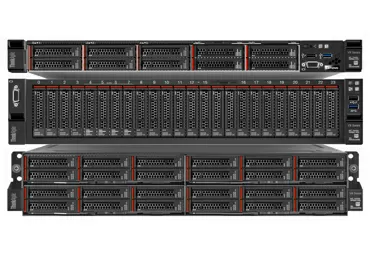
Lenovo ThinkAgile VX3320 review - a hyperconverged solution for simplified enterprise-wide vSAN deployment
Hyperconverged systems are rapidly gaining popularity and are already becoming the standard for building virtualization platforms in the corporate environment. Lenovo has released a special series of servers for installing and running VMware vSAN with tools for simplified administration and deployment at the customer's facility.
The ideology of hyperconvergent solutions using VMware technologies has its advantages: this is a relatively low cost at the start, and the ability to scale almost ...
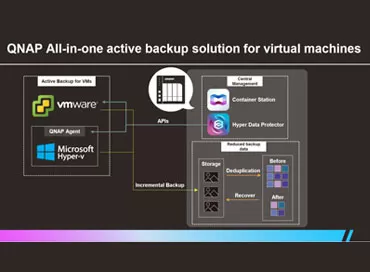
Storage and backup of virtual machines on QNAP NAS
In small companies, NAS can significantly reduce infrastructure costs. Those who decommissioned servers yesterday by moving resources to the NAS are canceling their subscriptions to the software that QNAP performs out of the box today. And now the time has come when QNAP swooped down on the sacred: the reservation of virtual machines.
In 2019, the world market for backup and data recovery software, according to estimates by Allied Market Research, amounted to $ 9.3 billion. An article of ...
QSAN XN8012R Storage Review: Virtualization + ZFS Onboard!
Many specialists of small organizations clearly understand the advantages of ZFS and can justify to the management the savings from software LZ4 compression and deduplication when buying a new storage system, but there were no inexpensive solutions for this file system. But a holy place is never empty, and QSAN decided to combine in one device everything that we love in Linux and everything that we value in ZFS.
Today, many technical experts believe that ZFS is something that works only ...
Big test Synology Active Backup for business - recovering from backup in 11 seconds!
... has a free solution to back up and restore all of its ... when, where and what to back up, uses global deduplication, taking into ... a separate machine inside the Virtual Machine Manager. You can restore several states ... our next task is to back up CIFS network file shares on ... Copy, which allows you to back up files opened in other programs ... guest systems are Linux, then back up the entire host and deploy ... virtualization to work under Synology VMM, although this recovery worked with VMware ...

Synology VMM Pro - testing failover virtualization cluster
Synology is expanding the capabilities of its hypervisor and in the Pro version it is possible to create a failover cluster. We tested non-stop migration, crash recovery and also showed how BTRFS can save disk space when using a dozen virtual machines. Traditionally for Synology, every step here is intuitive and logical.
Today any small company has its own IT resources, which grow along with the growth and development of the company. One or two services can still be kept on a dedicated ...
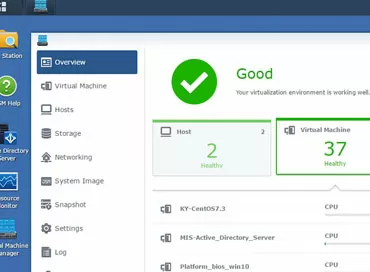
Synology Virtual Machine Manager hypervisor - first step into converged architectures
Synology has released a package that turns storage into a host for virtual machines with easy cluster setup, virtual machine snapshot support, and setup in just a few clicks. You can even run the DSM operating system itself in a virtual environment to create multitenant services within your organization.
Synology
, already a well-known system manufacturer to our readers data storage class SmB/SOHO, has been making steps towards the Enterprise segment for quite some time. In 2017, high- ...

Freebies will not be! VMware waives the license for the socket
It happened! Now, for every 32 physical cores in the server, you will need a license for 1 processor socket. Bad news for AMD, but don't jump to conclusions - there's still time to buy EPYC.
I hope you had time to enjoy how your new 1-socket server on AMD EPYC smartly replaces 2 or even 4 old servers on Xeon E5, and at the same time you deduct a mere penny for the hypervisor license? The freebie is over: now VMware changes the license policy, considering that there are no more than 32 cores ...