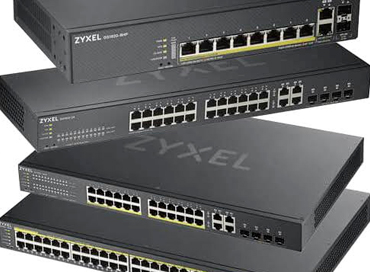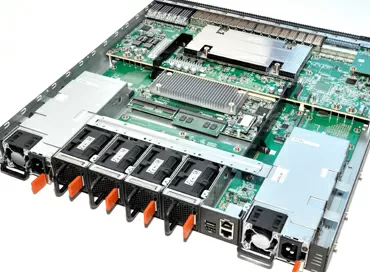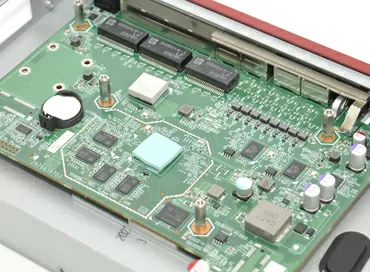
The model range of Zyxel switches
Zyxel is a large manufacturer that has been systematically building its business around the SMB and HoReCa segments for the past ten years. In our previous review of Wi-Fi 7 access points, we already showed that Zyxel's division is not based on marketing labels, but on completely engineering axes - customer density, uplink type, control modes and operating conditions; the story with switches is exactly the same, only the axes are different: the manageability class (from an unmanaged box to a full-fledged L3 core with dynamic routing), the PoE budget and power standard, as well as the design - from compact desktop and rack models to industrial switches with DIN rail mounting.
That is why choosing a Zyxel switch rarely comes down to a simple "how many ports are needed?"&"- GS1100 and GS1900 from the same price category can radically differ in control functionality, and externally similar XGS1935 and XGS2220 will differ in routing and stacking class so much that they solve completely different infrastructure tasks. In this review, we will analyze the product line into three practical groups - SOHO and small office, medium and large business, as well as industrial and auxiliary solutions.
SOHO segment: home office and small business
The lower tier of the Zyxel portfolio is devices that rarely come into the focus of the CIO, but they cover the lion's share of real installations: a small office with 5-10 workstations, a store, a studio, a hotel reception or an apartment with advanced home Wi-Fi. Here, the manufacturer relies not on the depth of management, but on the utmost simplicity: if you connect a cable, the network works, regardless of whether the administrator understands VLAN or sees the switch for the first time.
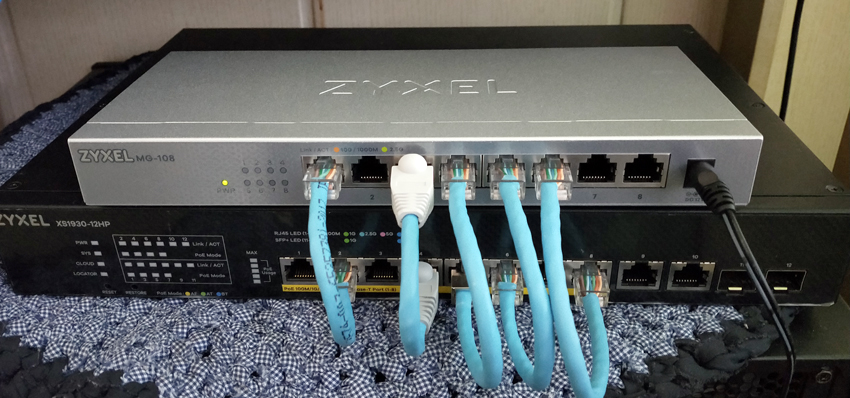
The base level of the segment is the compact desktop models GS-105B v5 and GS-108B v5, GS1005HP/GS1008HP, and the multi-gigabit XMG-105/XMG-108. Their common feature is QoS ports with hardware priority: for example, the GS-105B v5 has a dedicated high-priority port for an IP phone and a pair of medium-priority ports for NAS and workstations, which solves the problem of a "frozen" voice on an unmanaged switch without any configuration. The XMG-105/108 go further and extend this to the multi-gigabit level, offering 5 or 8 2.5GbE ports plus one 10G SFP+ port, allowing you to have a 10G backbone in your home studio or small-office network without purchasing a managed switch.
The next stage is the XGS1010-12 and its twin XGS1210-12 with web management: 8 GbE ports, 2 2.5G ports and 2 SFP+ 10G ports in one compact package.
The GS1100 series is a workhorse for those who don't need a web interface at all, but want at least some control. The GS1100 Switchable version (16S/16ES/16EPS/24ES) uses DIP switches directly on the case - three physical toggle switches include loop protection, IEEE 802.3az power saving, and LED shutdown, meaning the administrator gets basic control without a single click in the browser. The GS1100-16v4/16E/16EP/24E series goes a bit further and adds a full-fledged web interface with VLAN and PoE configuration, while remaining a virtually unmanaged switch.
GS1200 and GS1900/GS1915 close scenarios where simple plug-and-play is no longer enough. The GS1200 is an honest class of managed switches: VLAN, IGMP snooping, LACP and port mirroring in five variants from 5 to 10 ports, and PoE versions give up to 68 watts of total budget - enough for a couple of cameras and several access points. The GS1915 adds support for the Nebula cloud platform, which transforms a disparate set of switches in stores of the same network into a single-window managed infrastructure. The GS1900 extends this functionality with full-fledged Layer 2 management - there is already 802.1x authentication, STP/RSTP/MSTP, IPv6 support with dual stack and up to eight QoS prioritization queues, and the line is growing from compact 8-port models to 48-port switches with two SFP slots for optical uplink on remote segments. networks. At the same time, the PoE versions of the series (GS1900-24EP, GS1900-48HPv2) reach a budget of 166 W, which significantly expands the number of simultaneously powered cameras and access points compared to the GS1200, while remaining in the same price category for small businesses.
SOHO Segment Model Comparison
|
Model |
Ports |
Management |
PoE Budget |
Mounting |
Feature |
|
GS-105B v5 / GS-108B v5 |
5–8 × 1G |
Unmanaged |
— |
Desktop/Wall-mounted |
Hardware QoS ports for VoIP |
|
GS1005HP / GS1008HP |
5–8 × 1G |
Unmanaged |
60 W |
Desktop/wall mounted |
PoE+ on all ports with compact package |
|
XMG-105 / XMG-108 |
5–8 × 2.5G + 1×SFP+ |
Unmanaged |
— (HP versions up to 100W) |
Desktop/wall mounted |
10G uplink in an unmanaged enclosure |
|
XGS1010-12 / XGS1210-12 |
8×1G, 2×2.5G, 2×SFP+ |
Unmanaged / Web-managed |
— |
Desktop/Wall-mounted |
Auto-detect 100M/1G/2.5G |
|
GS1100-16S/16EPS/24ES |
16–24 × 1G |
Unmanaged + DIP-switch |
up to 135W (EPS) |
Rack/Desktop |
Physical DIP-switches for functions |
|
GS1100-16/16E/16EP/24E |
16–24 × 1G |
Web-managed |
up to 135 W (16EP) |
Rack/Desktop |
VLAN trunking via web at unmanaged-class price |
|
GS1200-5v3…10v3 |
5–10 × 1G (+2×SFP у 10v3) |
Web-managed |
up to 68 W (HP) |
Desktop/Wall |
LACP, IGMP snooping, port mirroring |
|
GS1900-8…48HPv2 |
8–48 × 1G + SFP |
Smart L2 |
up to 170 W |
Rack/table top |
PoE activation schedule |
|
GS1915-8…24EP |
8–24 × 1G |
Smart L2 |
up to 130 Watts |
Rack/table top |
NebulaFlex — cloud or standalone of your choice |
Let's move on to the next stage
Small business: once upon a time it was better for a small business than for anyone else.
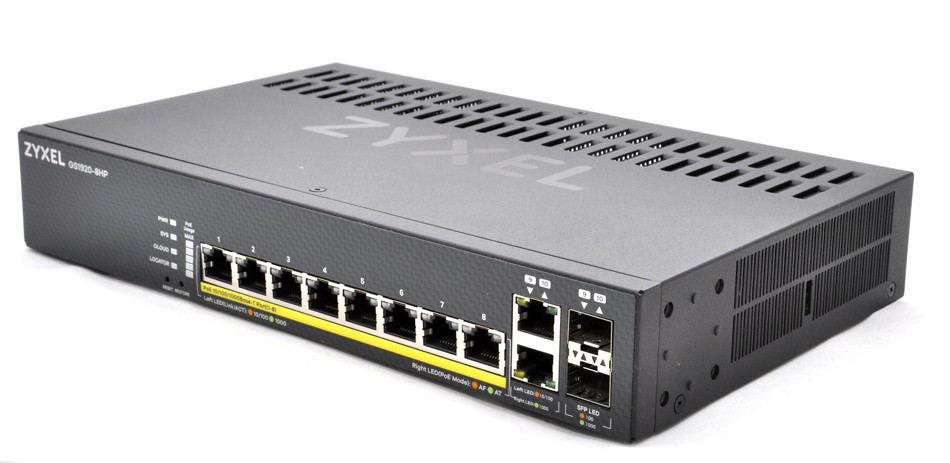
In small businesses, the network as a whole looks inconspicuous: most often, access points and IP phones are used, where cameras, cash registers, guest Wi-Fi, network wounded and other NETWORKS for employees. At this stage, unmanaged and basic web-based managed models are already becoming too simple: diagnostics, traffic prioritization, controlled PoE power, and the ability to centrally support multiple sites are needed. For such generators, Zyxel offers the GS1350, GS1920, GS2220, XMG1915 and XGS1935 ranges.
GS1350 - this series is specially designed for video surveillance, and includes models for 6, 12, 18 and 26 ports, and the older PoE options provide up to 375 watts of total budget, which is enough to power cameras even with heated housing. The special feature of the younger GS1350-6HP is the combination of three PoE+ ports and two PoE++ ports: such a switch can be installed locally, for example, behind a TV in a meeting room, at a cash register or in a small cabinet, and connect a more demanding device without buying a large PoE model.
GS1920 v2 (see our review) is a series for a classic office network, where not only port density is critical, but also manageability at the L2+ level. The 24 and 48 Gigabit port options are offered both without PoE and with a PoE+ budget of up to 375 watts; at the same time, the switches support NebulaFlex, meaning they can work independently or connect to Nebula for remote control. In a real installation, this is a good choice for an office, a store with several cash desks, or a small hotel: the network can be serviced locally, and with the advent of the second facility, it can be transferred to a cloud console without replacing equipment.
GS2220 (see our review) develops this idea towards a more responsible access network. The line includes both compact 10-port models and 28- and 50-port solutions. All of them can be mounted in a rack, and the PoE versions provide up to 375 watts of power. I always have a positive attitude towards switches that can be placed either on a table or in a rack, because this significantly prolongs the life cycle of the device.: we bought it and put it on the table, it's time to grow to a rack - put it in a rack, you don't need to throw anything away. Compared to GS1920 v2, there is already a full-fledged CLI mode and configuration via SNMP.
A separate branch is formed by the multi-gigabit XMG1915 and XGS1935. XMG1915 offers 2.5GbE on subscriber ports and 10G SFP+ for uplink, and the EP versions are capable of powering PoE++ devices according to the 802.3bt standard — this is the right foundation for modern Wi-FiFi 6E/7 access points and cameras with a rotary mechanism. The XGS1935 is chosen in cases where gigabit remains sufficient in the workplace, but the backbone should already be 10 Gigabit: four SFP+ ports allow you to connect a server, NAS, second switch or optical line without fighting for a single uplink.
Basic series for small businesses
|
Series |
The port formula |
Management class |
PoE |
Uplinks |
Key Features |
The optimal scenario |
|
GS1350 |
5-24 × 1G, up to 2 × SFP/Combo |
Smart L2 |
Up to 375 Watts, PoE+/PoE++ |
1G SFP/Combo |
Functionality for NVR, PoE++ and Nebula |
Video surveillance system |
|
GS1920 v2 |
8–48 × 1G, up to 6 × Combo/SFP |
Smart L2+ |
Up to 375 W, PoE+ |
1G Combo/SFP |
NebulaFlex: cloud or local management |
Office, store, hotel floor, multi-VLAN network |
|
GS2220 |
8–48 × 1G, up to 6 × Combo/SFP |
L2/L2+ |
Up to 375 W, PoE+ |
1G Combo/SFP |
Networked AV and advanced multicast |
Office with AV infrastructure, meeting rooms, and classrooms |
|
XMG1915 |
8–16 × 2.5G, 2 × SFP+ |
Smart L3 Lite |
Up to 180W, PoE++ |
2 × 10G SFP+ |
Multi-gigabit access and 802.3bt power |
Wi-Fi 6E/7, fast workstations, and a modern, compact office |
|
XGS1935 |
24/48 × 1G, 4 × SFP+ |
Smart L3 Lite |
Up to 375W, PoE+ |
4 × 10G SFP+ |
Four 10G uplinks with gigabit access |
Growing office, server room, NAS and multi-storey node connectivity |
If the network is built around conventional gigabit workstations and PoE devices, the GS1920 v2 and GS2220 are the most rational. When access points already require 2.5GbE, and servers or NAS start to run into gigabit, without XMG1915 or XGS1935, further infrastructure growth quickly turns into a compromise.
Medium and large businesses: L3 and core network switches
At this level, the network ceases to be a set of individual points and turns into an infrastructure with a clear hierarchy: access layer, aggregation and core. This already requires full—fledged routing between VLANs, power redundancy, stacking for fault tolerance, and a sufficient uplink margin of 10G, 25G, and at the very top, 100G. Zyxel closes this segment with the XGS2220, XMG2230, XS1930/XS1935 lines, as well as the L3 Core XGS4600, XS3800 and CX4800 switches, which already claim to be the core of the network.
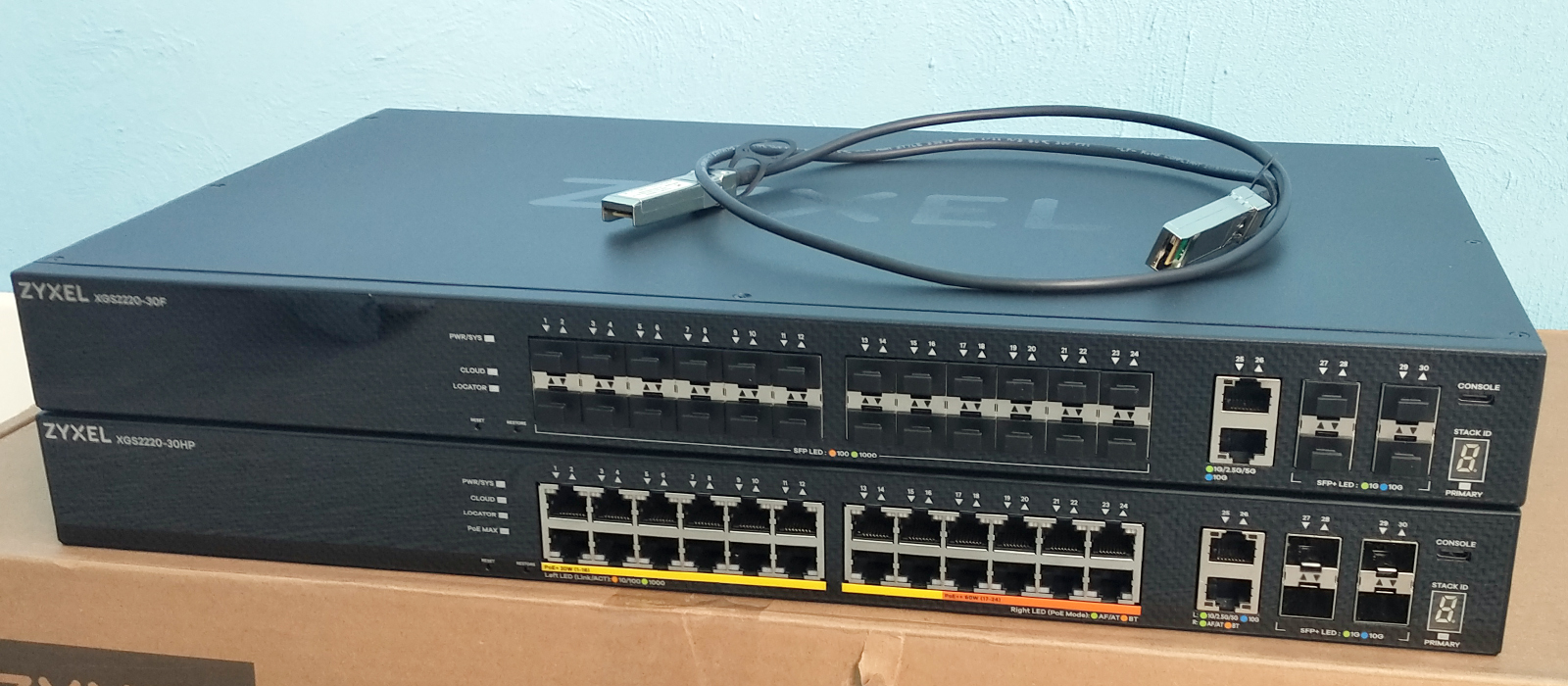
XGS2220 (see our review) is the first truly serious L3 Access series in the portfolio with the possibility of stacking. The port range is growing from compact 30-port versions to 54-port switches with gigabit access and 10G SFP+ uplinks, and PoE options like the XGS2220-54FP deliver up to 960 watts of total budget - enough to fully power a floor with cameras, access points, and IP telephony without a separate power cabinet. This is a reasonable choice where the L3 functionality of an "adult" switch is needed, but the budget and physical space are not yet designed for a full-fledged core.
XMG2230 brings the same L3 Access logic to the multi-gigabit world: 24 or 52 2.5GbE ports with four SFP+ 10G uplinks, and PoE versions are capable of delivering up to 1440 watts of total power when powered by AC and up to 2400 watts when powered by DC. Such a PoE budget margin is justified where the ports are not equipped with ordinary access points, but with a dense Wi-Fi 6E/7 network with external antennas, PTZ cameras, or thin clients - devices that are noticeably more voracious than a typical IP phone.
XS1930 and XS1935 (see our review) are compact 10 Gigabit L3 Access switches with eight to ten 10GBASE-T ports plus an SFP+ pair for uplink or cascading. The XS1935-12F has an interesting optical configuration - ten SFP+ ports and two 10G copper ports, which makes the model a convenient aggregation node where the vertical wiring between floors has already been done with optics rather than twisted pair. For networks with active internal migration to 10G (server rooms, video processing studios, storage nodes) This is one of the few compact options that do not force you to switch immediately to a full-size core chassis.
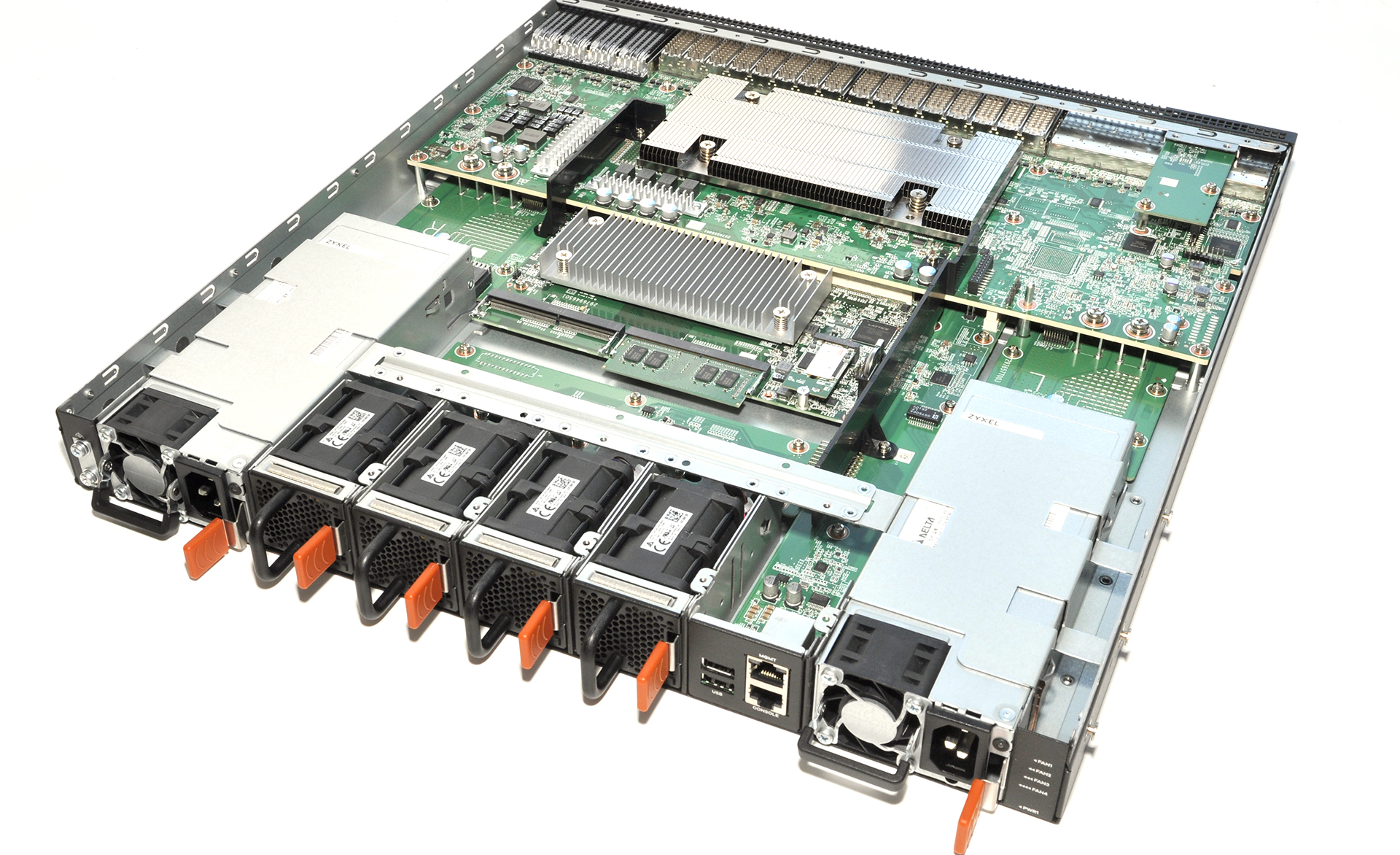
At the top of the line are L3 Core class switches — XGS4600, XS3800 and CX4800. XGS4600 combines 24-48 Gigabit or SFP ports with four SFP+ uplinks and full dynamic routing. The XS3800 goes further: 24 SFP+ ports and combined 10G interfaces make it a suitable core for a multi-XGS2220 network (see our review) or XS1935. A CX4800-56F (see our review) is a different class of tasks: 48 SFP28 ports for 25G and eight QSFP28 ports for 100G, support for L3, stacking and backup power (including the DC-powered version for telecom facilities) transform It will be integrated into a switchboard designed to serve as the core of a mini-data center or a backbone between campus buildings, and not just a "top-of-the-line model."
Medium and large business series
The CX3800 occupies an intermediate step between aggregation switches like the XS3800 and the top-end data center CX4800: L3 Aggregation class, but with 25G and 100G uplinks on board. There are three models in the line - the CX3800-30 with copper ports (16×10G Multi-Gig RJ-45 + 8×SFP+), the CX3800-30F in a purely optical design with 24 SFP+ ports for long-range aggregation lines from access switches, and the CX3800-30HP with PoE++ on all 24 copper ports. The PoE version has an interesting flexible power layout: the first eight ports are capable of delivering 90 watts (802.3bt), the remaining sixteen are 60 watts each, and the total budget reaches 1200 watts when installing two power supplies - a rare case when the aggregation switch is able to directly power dozens of demanding PoE devices, and not just forward 10G traffic is higher in the hierarchy. All three models received the same four 10G/25G SFP28 ports and a pair of 100G QSFP28 with physical stacking support, as well as proprietary Networked AV Mode with auto-tuning via the AI master - Zyxel explicitly declares support for lossless 4K video streams on top of 10GbE without delay. Redundancy via a dual power supply with automatic switching makes the CX3800 a reasonable choice where an aggregation node needs to work without downtime - a medium-sized company's server room, a campus network node, or a backbone between floors with dense PoE facilities.
|
Series |
Port formula |
Class |
PoE |
Apples |
Key feature |
Optimal scenario |
|
XGS2220 |
10–54 × 1G, 2×10G, 4×SFP+ |
L3 Access |
Up to 960W, PoE+/PoE++ |
2×10G + 4×SFP+ |
Networked AV interface |
Floor of the office with dense PoE, conference areas, hybrid network |
|
XMG2230 |
24–52 × 2.5G, 4×SFP+ |
L3 Access |
Up to 1440W, PoE++, AC/DC reserve |
4×SFP+ 10G |
Multi-gigabit with redundant power |
Dense Wi-Fi 6E/7, PTZ cameras, demanding access points |
|
XS1930 / XS1935 |
8–10 × 10G, 2×SFP+ |
L3 Access |
Up to 400W (HP-versions) |
2×SFP+ 10G |
Compact fully 10G switch |
Server room, aggregation node, video production |
|
XGS4600 |
24–52 × 1G/SFP, 4×SFP+ |
L3 Core |
- |
4×SFP+ 10G |
Stacking up to 4 devices |
The core of the small data center network, server room |
|
XS3800 |
16×SFP+, 8×Combo10G, 4×10G |
L3 Core |
- |
10G/SFP+ |
High density of 10G ports |
Aggregation of multiple access switches |
|
CX3800 |
16–24 × 10G, 4×SFP28, 2×QSFP28 |
L3 Aggregation |
Up to 1200W, PoE++ (90/60W) |
4×25G + 2×100G |
25G/100G uplinks and stacking via QSFP28 |
Dense PoE aggregation node, campus backbone |
|
CX4800-56F |
48×SFP28 (25G), 8×QSFP28 (100G) |
L3 Core |
- |
100G QSFP28 |
AC and DC power support, stacking |
Data center core, campus backbone |
If the goal is to build a fault-tolerant access layer with L3 routing and PoE, the XGS2220 and XMG2230 are a reasonable starting point; however, when it comes to the network core or inter-building backbone, the choice narrows to the XGS4600, XS3800, and CX4800, depending on whether you need additional 10G ports or a full transition to 25G/100G.
Industrial and Support Solutions
A separate category in the Zyxel lineup is equipment designed for use in a switchboard, production facility, outdoor cabinet, or local power supply for a single device. In this category, the focus is on temperature range, power type, and mounting methods.
RGS100-5P is a compact unmanaged DIN-rail switch with 4 1G ports, 1 SFP port, 4 PoE+ ports (802.3af/at) with a PoE budget of up to 120 watts. The power supply is DC, the operating temperature range is extended for the panel design, fanless housing. This is a point-to-point solution for a single automation cabinet where 3-4 cameras or access points need to be powered.
RGS200-12P is a managed L2/L2+ switch of the same series with a DIN rail: 8 1G ports, 4 SFP, up to 8 PoE+ ports and a total power budget of 240 watts. Unlike the RGS100, it has VLAN, QoS, and basic L2+ functionality. DC power supply and industrial enclosure allow it to be installed in unheated rooms and outdoor cabinets.
Comparison of Industrial and Auxiliary Models
|
Model |
Ports* |
Management |
PoE-budget |
Power supply |
Installation/execution |
|
RGS100-5P |
4×1G + 1×SFP |
Unmanaged |
120 Вт, PoE+ |
DC |
DIN-рейка, Industrial |
|
RGS200-12P |
8×1G + 4×SFP |
L2/L2+ |
240 Вт, PoE+ |
DC |
DIN-рейка, Industrial |
|
PoE12-30W |
2×2.5G |
Unmanaged |
30 Вт, PoE+ |
AC |
Настольный/настенный |
|
PoE12-60W |
2×10G (5G)** |
Unmanaged |
60W, PoE++ |
AC |
Desktop/Wall |
|
PoE12-90W |
2×10G** |
Unmanaged |
90W, PoE++ |
AC |
Desktop/Wall |
|
PoE12-3PD |
4×1G |
Web-managed |
45W, PoE+ |
PoE |
Wall/pole, Outdoor, Nebula |
* - the table above shows the total number of ports (input + output) for PoE injectors.
** - PoE12-60W supports 10Gbe only over CAT6A or higher cable, up to 30 meters. On CAT5, the speed is limited to 5G.
The line of PoE injectors (PoE12-30W, PoE12-60W, PoE12-90W, PoE12-3PD) covers point tasks where it is redundant to build a separate PoE segment. PoE12-30W and PoE12-60W are simple two-port devices on 2.5G/5G with a fixed budget of 30 and 60 watts, respectively, while PoE12-90W raises the bar to 90 watts according to the 802.3bt standard to power more power-hungry access points. PoE12-3PD stands out: it is a managed model with an outdoor design (IP housing, Wall/pole mounting) that can receive power via PoE and distribute it to three ports. This model is managed via Nebula. It is an excellent option for installing an access point and an IP camera high up on a mast, where it is impractical to install a full-fledged switch.
How to choose in a real project
In practice, the choice of a switch almost never comes down to a single model - a typical small or medium-sized business network is a combination of several classes at once. The main practical conclusion is simple: the Zyxel line-up is structured in such a way that almost any network can be built in stages, without throwing away the already purchased equipment. Starting with junior SOHO models and gradually adding L2+/L3 functionality is a working strategy for a growing business, where the budget is allocated in parts, rather than in one large investment.
And where the scale is clear from the first day - a large office, campus, data center - it is more reasonable to immediately lay out L3 Core at the level of XGS4600 or CX4800, because it is always more expensive and risky to grow the network core under load than to design it with a margin from the very beginning. For such purposes, the company also has everything ready.
Michael Degtyarev (aka LIKE OFF)
03/08.2026